

 English
 中文简体
中文简体 عربى
عربى Español


How to Check Universal Joints: Symptoms, Tests and Replacement Guide Steps
Posted by Admin | 11 Sep
Content
You shift from Park into Reverse, and a sharp clunk comes from under the car. You move into Drive, and it repeats. Or you accelerate on the highway and feel a rhythmic vibration through the seat and floor. Both symptoms often point to one part: a universal joint.
Good news: checking a universal joint does not require removing heavy components or raising the vehicle to a full working height. A standard visual, hand, and rotation check gives you a clear answer in about five minutes. Below, I will walk you through the exact steps and the pass/fail criteria.
Signs of a Worn U-Joint
Worn universal joints rarely stay silent. If you notice any two of the following, schedule an inspection.
- Clunking during gear engagement: When the transmission takes up torque, a loose U-joint lets the needle bearings strike against the cross shaft, producing a metallic knock.
- Speed-dependent vibration: The shake gets faster as you accelerate, and you can feel it in the steering wheel, the seat, and the floor. It is usually most noticeable between 25 and 50 mph.
- High-pitched squeal at low speed: A dry or damaged U-joint emits a thin metallic squeal, especially on a cold start.
- Rhythmical clicking in corners: If the noise changes with the steering angle, the issue may be in the outer CV joint on a front-wheel-drive half shaft.
Note: if the dust boot is broken but the joint has not started making noise, the U-joint can still spin. However, dust has already entered the assembly, which can shorten the needle bearing life.
How to Prepare the Vehicle for Inspection
Safety comes first. Use this standard sequence before you touch the driveshaft.
- Park on a flat, hard surface, apply the parking brake, and block at least two wheels with wheel chocks.
- Move the transmission to Neutral. If the car is automatic, select N and release the shifter so the driveshaft is free to turn.
- Raise the vehicle until the tires are off the ground, and support the chassis with safety stands. Never rely on a hydraulic jack alone.
Brush away mud and dirt from the driveshaft area, then shine a work light on the U-joint. This helps you distinguish between surface rust and a real crack, and it makes grease leaks easier to spot.
Three Inspection Methods That Give You a Clear Answer
These checks require no special tools, only your hands, a light, and patience. Together they cover the entire failure chain from outside to inside.
Visual Check: Look for Cracks and Missing Grease
Use a work light from different angles and check the following.
- Dust boot condition: If the boot has a crack or puncture, even a small one, grease has already started to escape.
- Rust depth: Surface rust may be cosmetic, but flaking or peeling rust indicates that metal has degraded.
- Connecting bolts: Grip the universal joint flange and shake it. If you feel movement, the retaining bolts or splines may be loose.
Hand and Torque Test: Feel the Play
Hold the driveshaft on one side of the U-joint with one hand and the flange on the other side with your other hand. Try to twist the flange in opposite directions. A healthy U-joint gives almost no perceptible angular movement. If you can feel more than about 1 mm of free play, the needle bearings have already worn and the joint needs replacement.
For front-wheel-drive half shafts, use the same method to check the inner and outer CV joints. The outer joint is more prone to wear because it handles a larger steering angle.
Driveshaft Rotation Test: Listen for Irregularities
Slowly rotate the driveshaft through one full turn. Pay attention to any sudden resistance or a rough spot. If you hear a cracking sound or feel a catch, the needle rollers or the surface of the cross shaft has spalled. Rotate in reverse once more and compare the resistance.
What the Test Results Mean
Match what you observed against the table below to get a quick diagnosis and the recommended action.
| Inspection Finding | Possible Cause | Recommended Action |
|---|---|---|
| Cracked or punctured dust boot | Rubber aging, stone impact, or cold brittleness | Replace the boot and repack grease; if the joint already has play, replace the whole U-joint |
| More than 1 mm of play when twisted by hand | Worn needle bearings or cross shaft end wear | Replace the U-joint assembly |
| Cracking sound during rotation | Spalled needle rollers or damaged cage | Replace immediately, and inspect the splines and bearings |
| Vibration that increases with speed | Out-of-round U-joint or bent driveshaft | Perform wheel alignment first, then replace the U-joint or driveshaft |
Procurement risk reminder: a U-joint is press-fitted onto the driveshaft. During replacement, you must use a press tool and apply a high-temperature lubricant. Hitting the cross shaft with a hammer can damage the bearing cups and shorten the life of the new part.
What to Do If You Find a Failed U-Joint
If your results fall into the play or noise zone, the only correct answer is replacement. U-joints are wear parts; there is no practical repair. Continuing to drive expands the gap and can eventually send the driveshaft out from under the car.
When selecting a replacement, pay attention to three technical points.
- Size and spline match: The outer diameter, cross shaft length, and spline count must match the original. A 1 mm error can cause binding or high-speed vibration.
- Complete sealing set: A new U-joint must come with a new dust boot and clamp. Otherwise, dust will destroy the needle bearings within weeks.
- Machining tolerances: A quality U-joint should have uniform rotational damping, with no angle where it feels particularly tight.
For front-wheel-drive half shafts, the inner and outer CV joints are often sealed assemblies. The outer joint wears faster because it handles larger steering angles and will produce clicking. The inner joint allows axial sliding and will produce a clunk during launch. You can replace only the failed side based on your inspection.
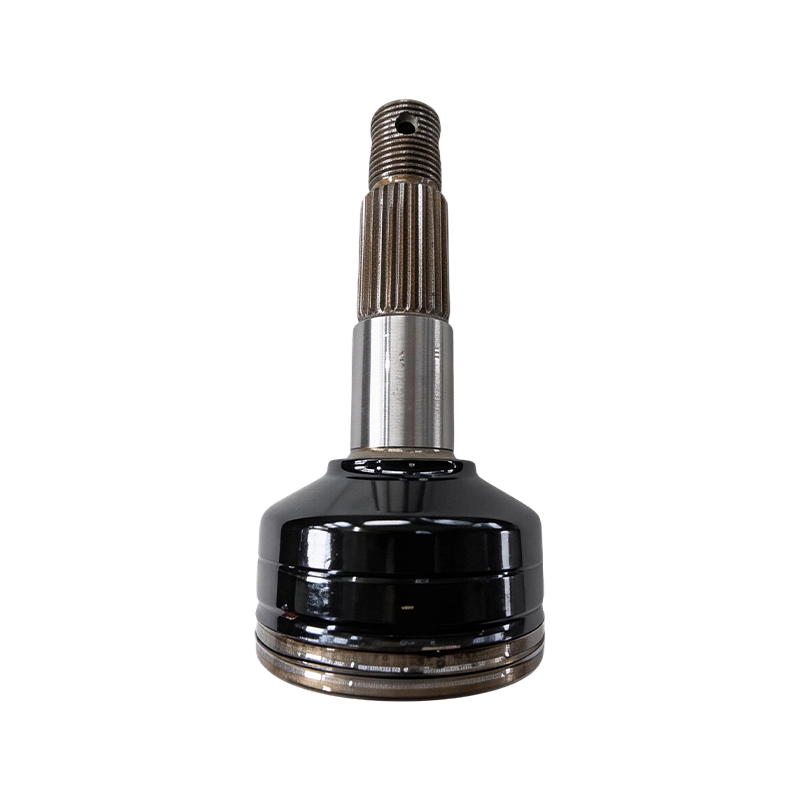 Outer CV Joint for High-Angle Steering ApplicationsReplacement outer CV joint with high-strength alloy steel and hardened surfaces, paired with a CR boot and MoS2 grease. Designed for front-wheel-drive half shafts and smooth power delivery under steering load.View Product →
Before ordering an outer CV joint, verify the vehicle make, spline count, and roller track diameter. A precise match ensures stable steering and acceleration throughout its service life.
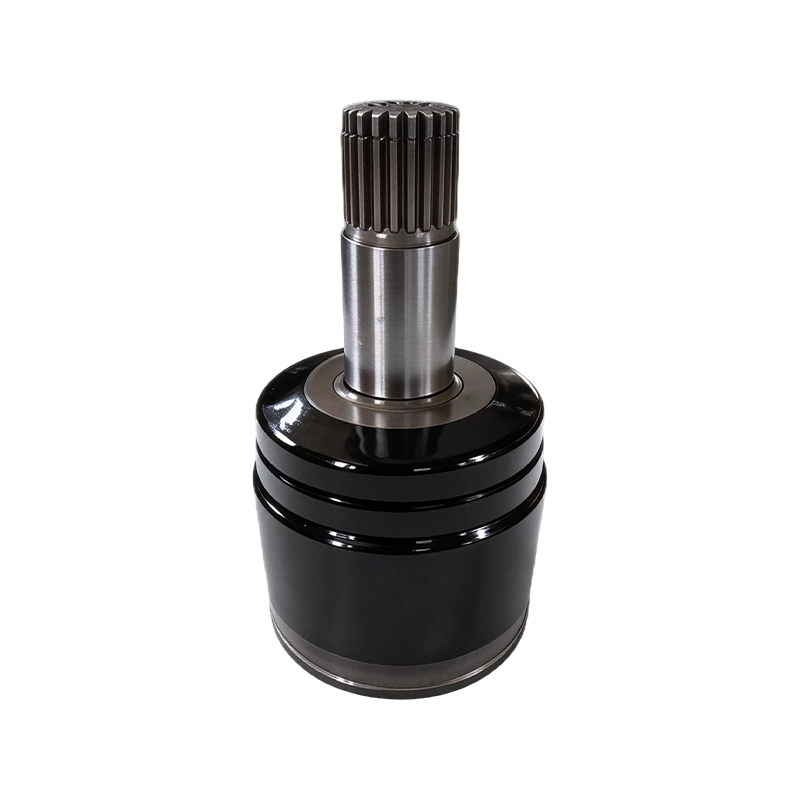 Precision Inner CV Joint with Low Sliding ResistancePlunging inner CV joint with optimized tripod structure, forged steel, and all-weather sealing. Reliable for compensating suspension travel, reducing vibration, and resolving launch clunks.View Product →
Inner CV joints take extra lateral loading during sliding, so machining tolerance matters. If your vehicle has a launch clunk, inspecting the inner CV joint often identifies the problem immediately.
The driveline is a continuous kinetic chain, and the U-joint is only one link. If you want to understand how the driveshaft, half shafts, and differentials work together, read our introduction to driveline components. This article helps you decide whether U-joint failure has already affected nearby bearings, or whether you should replace the boot kit at the same time.
MAIL US
CONTACT US
+86 133 0665 0391
MAIL US
No. 169 Songpu Road, Cidong Industrial Zone, Cixi City, Ningbo City, Zhejiang Province, China
 OEM/ODM Automotive Chassis Sealing Components Manufacturer
EV Drivetrain Components Supplier
OEM/ODM Automotive Chassis Sealing Components Manufacturer
EV Drivetrain Components Supplier