Content
A driveline consists of several critical components that work together to transfer engine power to the wheels: the CV axle assembly (drive shaft), inner and outer CV joints, prop shaft, intermediate shafts, CV boot kits, and related repair hardware. Each part plays a distinct role in ensuring smooth, reliable power delivery — whether in a compact passenger car, a light commercial vehicle, an ATV, or a next-generation electric vehicle. Understanding what these components are, how they interact, and how to maintain them is essential knowledge for automotive engineers, fleet managers, and procurement professionals worldwide.
This article provides a comprehensive breakdown of every major driveline component, explains the engineering principles behind each one, identifies common failure modes, and offers practical guidance on selection and maintenance. Whether you are sourcing replacement parts at scale or simply need a thorough technical reference, the information below covers the full picture of modern driveline systems.
Before examining individual components, it is worth clarifying a common point of confusion. The term drivetrain encompasses the entire system responsible for generating and delivering power — including the engine, transmission, and all downstream components. The driveline, by contrast, refers specifically to the assembly of shafts, joints, and related parts that transmit rotational force from the transmission output to the drive wheels, excluding the engine and transmission themselves.
This distinction matters because driveline components experience different types of stress than powertrain components. They must cope with constant angular velocity changes, steering angles, suspension travel, and — in off-road applications — extreme articulation. Specifying or replacing driveline parts therefore requires a precise understanding of vehicle layout, load requirements, and operating environment.
Modern driveline systems are engineered around a set of well-defined components. While the exact configuration varies by vehicle type (FWD, RWD, AWD/4WD), the following parts appear across nearly all platforms and represent the backbone of any driveline assembly.
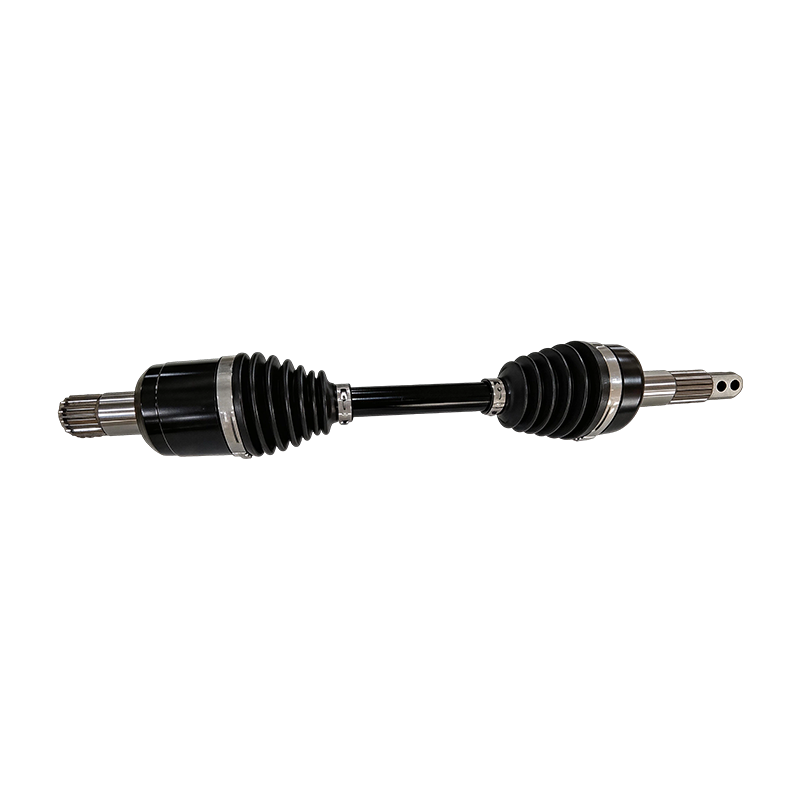
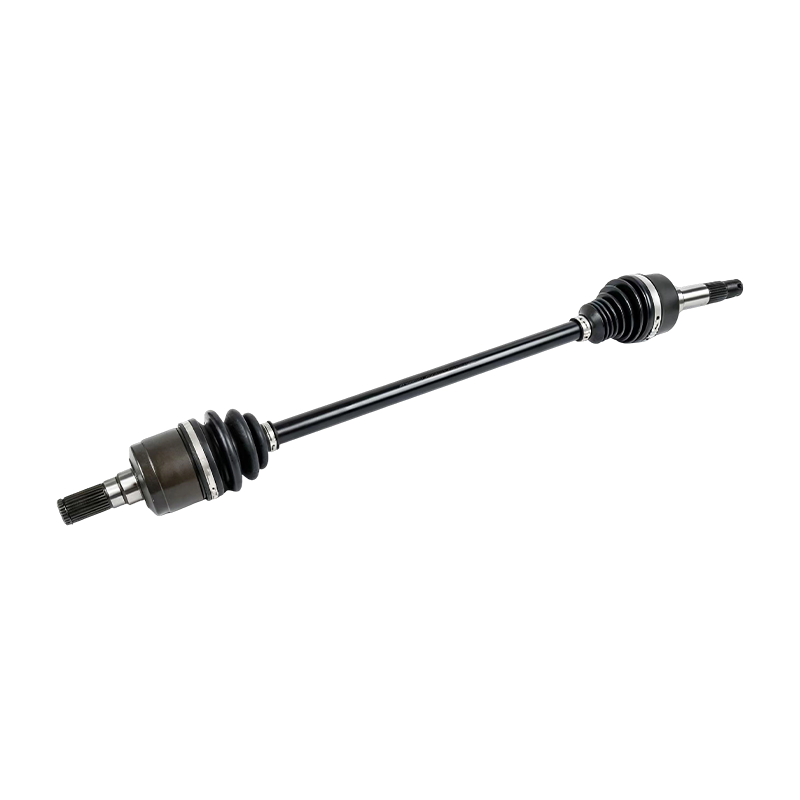
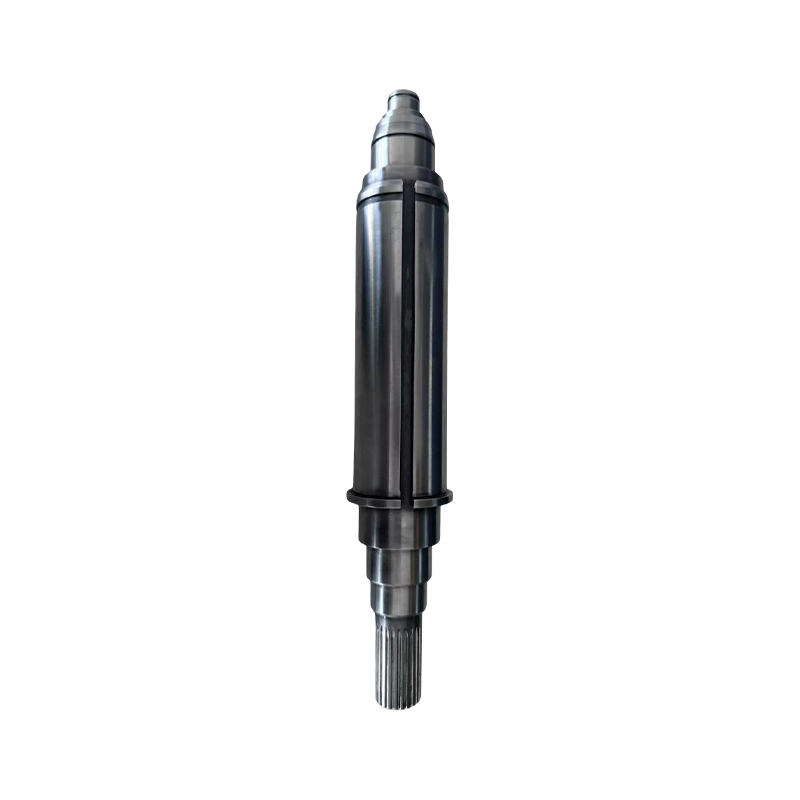
The CV axle assembly — also referred to as a half shaft or drive shaft — is the primary power-transmission link between the transmission and the wheel hub. In front-wheel-drive and all-wheel-drive vehicles, each driven wheel is served by one CV axle. The shaft is typically constructed from high-strength steel, machined to tight tolerances to minimize vibration and ensure long service life.
A complete CV axle assembly integrates both an inner and outer CV joint, the interconnecting shaft, and protective boots pre-packed with grease. When sourcing CV axle assemblies for the passenger vehicle or light commercial vehicle market, buyers should verify OE fitment compatibility, shaft length tolerances, and spline count, as these parameters vary widely across vehicle platforms.
The outer CV (constant velocity) joint connects the drive shaft to the wheel hub and must accommodate both power transmission and the full range of steering angles — often up to 47° or more on modern vehicles. The most common design is the Rzeppa ball-and-groove joint, which uses six or eight steel balls held in a cage between an inner race and outer housing to maintain constant rotational velocity regardless of joint angle.
Outer CV joints are subjected to higher angular stress than inner joints due to steering inputs. Premature wear is most often caused by a torn CV boot that allows grease to escape and contaminants to enter. A clicking or popping noise during low-speed cornering is the classic symptom of a failing outer CV joint and should be addressed promptly to avoid complete joint failure.
The inner CV joint connects the drive shaft to the transmission or differential. Unlike the outer joint, it must accommodate both angular movement and axial (in-and-out) plunge to account for suspension compression and rebound. The two most common inner joint designs are the tripod (tulip) joint and the cross-groove joint, each offering different trade-offs in terms of plunge capacity, efficiency, and NVH (noise, vibration, and harshness) characteristics.
Tripod joints, which use three roller-tipped trunnions riding in three grooves, are widely used in high-torque FWD applications because of their high plunge capacity and relatively low manufacturing cost. Cross-groove joints are preferred in applications where NVH refinement is the priority, making them common in premium passenger vehicles and AWD systems.
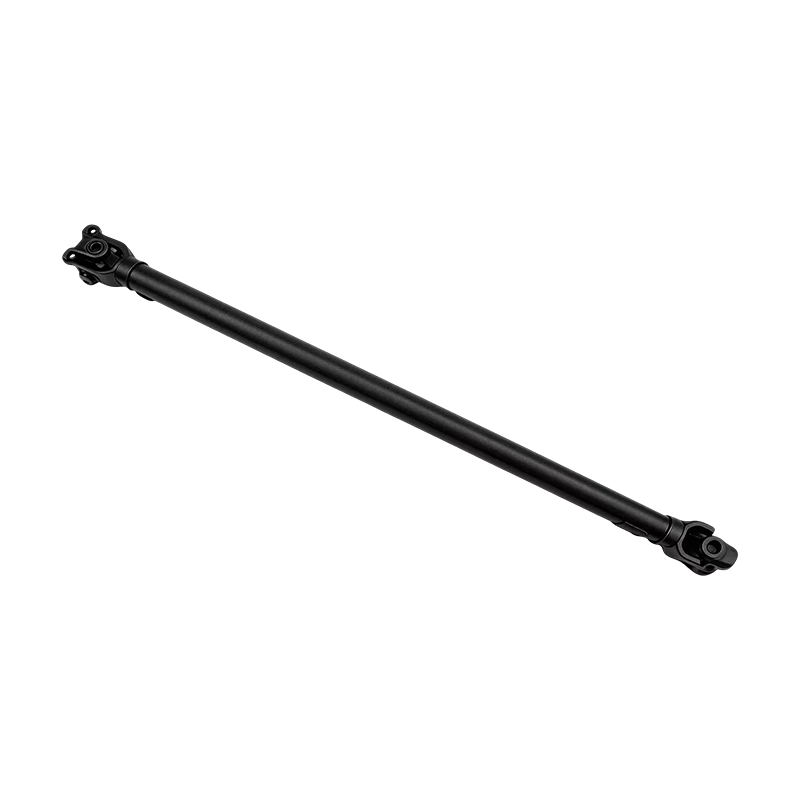
The prop shaft, also known as the propeller shaft or Cardan shaft, is the long rotating shaft that connects the gearbox to the rear axle differential in rear-wheel-drive and four-wheel-drive vehicles. In longer vehicles, a two-piece prop shaft with a center bearing support is used to reduce critical resonance speed and vibration.
Traditional prop shafts use universal joints (U-joints) at each end, which — unlike CV joints — do not deliver perfectly constant rotational velocity, introducing a cyclic speed variation that can cause vibration if phasing is incorrect. Modern designs increasingly incorporate CV-type joints or double-cardan joints at one or both ends to improve NVH performance, a trend particularly evident in pickup trucks and SUVs designed for both on-road comfort and off-road capability.
Some vehicle layouts — particularly those with transversely mounted engines in FWD and AWD configurations — require an intermediate shaft (also called an equal-length shaft or inner stub shaft) between the transmission and one of the CV axles. Its purpose is to equalize the length of the left and right drive shafts, thereby eliminating torque steer: the tendency of a vehicle to pull to one side during hard acceleration that occurs when unequal shaft lengths create unequal joint angles.
The intermediate shaft is supported by a bracket bearing mounted to the engine block or subframe, which absorbs the shaft's dynamic loads and maintains proper alignment. Bearing failure in the intermediate shaft support is a relatively uncommon but diagnostically important failure mode, typically manifesting as a vibration that increases with vehicle speed rather than with steering angle.
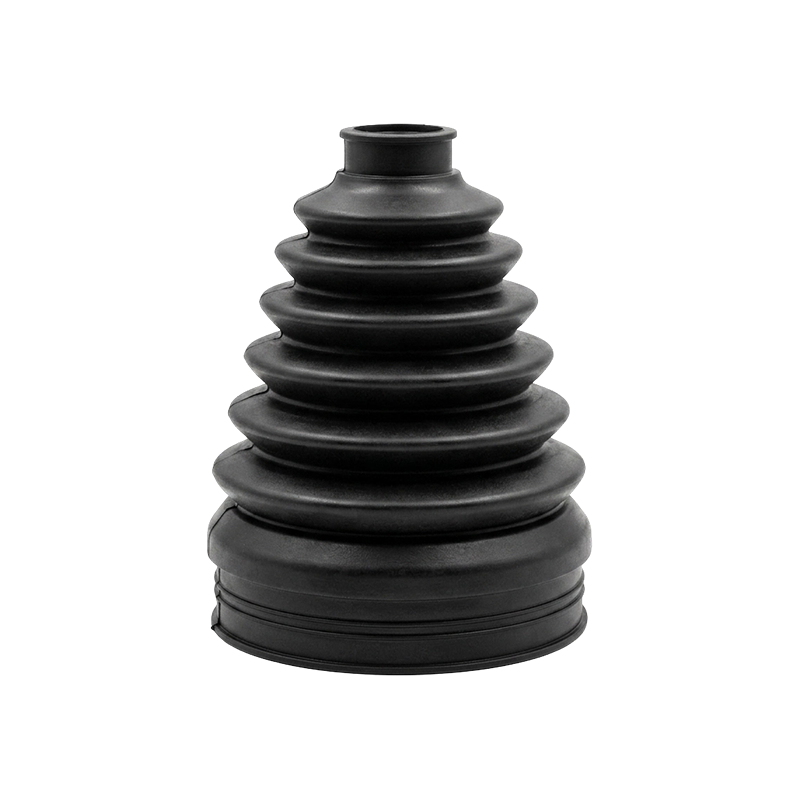
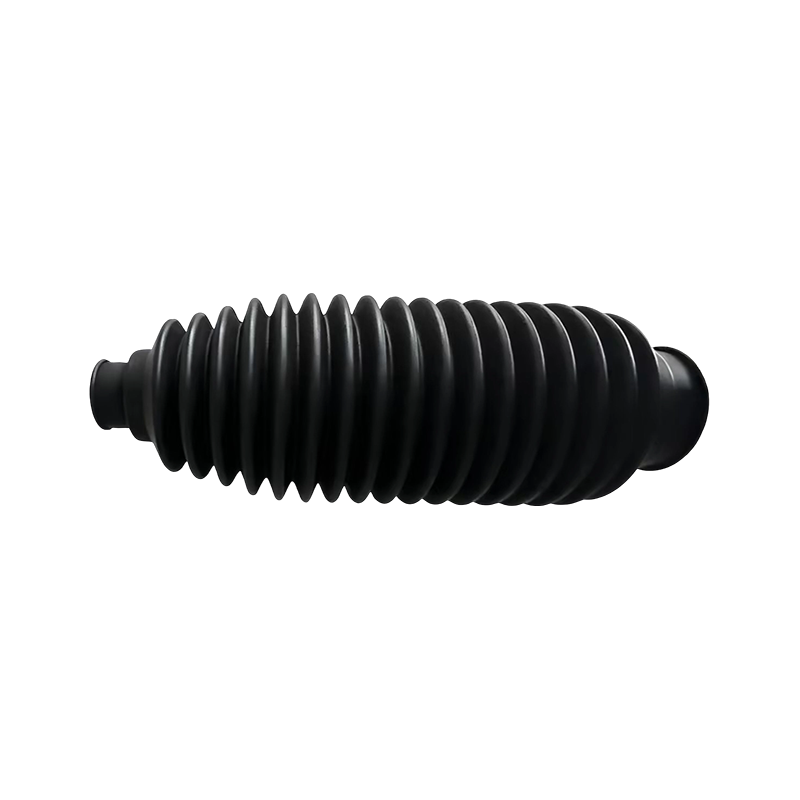
The CV boot is the accordion-style rubber or thermoplastic elastomer (TPE) sleeve that encases each CV joint. Its sole purpose is to retain the lubricating grease inside the joint while excluding road contaminants such as water, grit, and road salt. Despite being one of the least expensive components in the driveline, the CV boot is arguably the most maintenance-critical: a cracked or torn boot will cause a serviceable CV joint to fail within a relatively short period.
CV boot kits typically include the replacement boot (in CR neoprene or thermoplastic elastomer), clamps, and the specified quantity and grade of grease. Selecting the correct boot profile — defined by large diameter, small diameter, and compressed/extended length — is critical for proper sealing. Incorrect fitment leads to premature boot failure through contact with suspension components or through stress concentration at fold points.
Off-road and recreational vehicles present unique driveline challenges. ATV, UTV, and SSV axle shafts must endure extreme articulation angles, shock loads from impacts, and continuous exposure to mud, water, and abrasive debris — conditions far more severe than typical passenger car service. As a result, these shafts are generally built to higher material and plating specifications, with reinforced boots and heavy-duty clamps designed to maintain integrity under aggressive use.
The growing global market for off-road recreational vehicles has driven significant product development in this segment. Buyers sourcing ATV/UTV axle shafts should pay particular attention to OEM fitment data, shaft diameter, spline specification, and the certification standards applicable to their target markets.
The rapid global adoption of electric vehicles (EVs) and new energy vehicles (NEVs) has created demand for a new category of driveline component: the EV/NEV motor shaft. Unlike conventional internal combustion engine vehicles, battery electric vehicles deliver peak torque instantaneously from standstill, imposing different load profiles on driveline components. Motor shafts for EV applications must therefore be engineered for high-cycle fatigue resistance, tighter dimensional tolerances, and compatibility with the higher rotational speeds typical of electric motor-driven systems.
Manufacturers with established expertise in precision driveline components — including advanced R&D capability and access to modern CNC machining and inspection equipment — are well positioned to meet the specific demands of EV platform developers and tier-one suppliers seeking reliable, OEM-compatible motor shaft solutions.
The table below summarizes the primary function, most common failure symptom, and recommended inspection interval for each major driveline component. This reference is particularly useful for maintenance engineers, workshop technicians, and procurement teams responsible for managing multi-vehicle fleets.
| Component | Primary Function | Common Failure Symptom | Recommended Inspection |
|---|---|---|---|
| CV Axle Assembly | Transmit engine torque to drive wheels | Vibration under load; grease spray on wheel interior | Every 12 months or 20,000 km |
| Outer CV Joint | Allow steering movement at constant velocity | Clicking / popping during low-speed turns | At each tire rotation service |
| Inner CV Joint | Accommodate suspension plunge and angle | Vibration or shudder on acceleration | At each tire rotation service |
| Prop Shaft | Connect gearbox to rear axle differential | Drivetrain vibration increasing with road speed | Every 40,000–60,000 km |
| Intermediate Shaft | Equalize shaft length; eliminate torque steer | Speed-dependent vibration; bearing noise | At each major service interval |
| CV Boot Kit | Seal joint grease; exclude contaminants | Cracking; grease leakage; visible tear | Every 12 months; replace immediately if damaged |
| ATV/UTV Axle Shaft | Power delivery under extreme off-road conditions | Clicking; shaft breakage under impact load | After every significant off-road session |
| EV/NEV Motor Shaft | Connect e-motor to driveline at high speed/torque | Abnormal NVH; reduced regenerative efficiency | Per vehicle OEM schedule |
Understanding how driveline components interact in sequence helps clarify why each part must be specified and maintained with precision. The following describes a typical front-wheel-drive power flow path, which is the most common configuration in the global passenger car market:
In rear-wheel-drive and four-wheel-drive vehicles, the power flow adds a prop shaft between the gearbox and the rear differential, with universal joints or CV joints at each end of that shaft accommodating the angle between the transmission tunnel and the rear axle. The same principles of joint angle, lubrication, and boot integrity apply throughout.
One of the most important dimensions of driveline component selection is the vehicle category. Passenger cars, off-road recreational vehicles, and electric vehicles each impose distinct performance requirements that influence material choice, joint design, and manufacturing tolerances.
This category represents the highest volume market for driveline components globally. The primary requirements are OE dimensional compatibility, NVH performance, and service life under normal road conditions. Coverage breadth is a key procurement criterion — a reliable supplier for this segment should offer cross-references that match the majority of best-selling vehicle models in target markets, spanning European, American, and Asian nameplates.
Aftermarket quality for passenger car driveline components is assessed primarily through dimensional conformance to OE specifications, metallurgical properties of the joint races and balls, and consistency in grease type and quantity. Parts produced with advanced inspection equipment — including CMM (coordinate measuring machine) verification and hardness testing — consistently outperform those without formal quality control processes.
Off-road vehicles operate under load conditions that are categorically more severe than those encountered on paved roads. Articulation angles can exceed 30°, shock loads from rocky terrain can introduce instantaneous torque spikes far above steady-state values, and mud or water ingress is a constant risk. Driveline components for this sector require heavier wall shafts, reinforced joint housings, and boots made from materials with superior abrasion and puncture resistance.
The global UTV and side-by-side market has grown substantially, with recreational and utility applications spanning agriculture, construction site logistics, resort management, and military use. Manufacturers that invest in mold tooling for a wide range of ATV/UTV fitments — and maintain rigorous product testing under simulated off-road conditions — are able to serve this diverse demand effectively.
The transition to electrification is reshaping driveline component requirements in fundamental ways. EV motors can spin at significantly higher speeds than internal combustion engines — in some configurations exceeding 15,000 RPM — which demands motor shafts with exceptional dynamic balance and surface finish. The absence of a traditional multi-speed gearbox in many EV platforms also changes the load cycling pattern seen by driveline components, requiring fatigue life analysis under different input spectra.
Suppliers with strong R&D capabilities and the flexibility to develop custom components from engineering drawings are best positioned to support EV platform developers. The ability to produce prototypes, validate them through bench testing, and scale into production with consistent quality is increasingly a differentiating factor in the NEV supply chain.
For procurement engineers and aftermarket distributors, selecting driveline components involves balancing several competing criteria. The following checklist identifies the most important factors to evaluate when qualifying a supplier or reviewing a product range:
Early and accurate diagnosis of driveline failures avoids secondary damage to related components such as wheel bearings, hubs, and differentials. The table below maps the most frequently encountered driveline failure symptoms to their probable causes, enabling faster and more accurate field diagnosis.
| Symptom | Probable Component | Likely Cause | Recommended Action |
|---|---|---|---|
| Clicking / popping in turns | Outer CV joint | Worn/contaminated joint due to torn boot | Replace outer CV joint or full axle assembly |
| Vibration / shudder on acceleration | Inner CV joint | Worn tripod rollers or contaminated grease | Inspect and replace inner joint or full axle |
| Speed-proportional driveline vibration | Prop shaft / intermediate shaft | U-joint wear, imbalance, or center bearing failure | Inspect U-joints; check balance; replace bearing |
| Grease on inside of wheel | CV boot | Torn or cracked boot | Replace boot kit immediately; inspect joint |
| Vehicle pulls during hard acceleration | Intermediate shaft / bearing | Shaft length imbalance; worn support bearing | Inspect and replace intermediate shaft assembly |
Proactive maintenance is far more cost-effective than reactive replacement, particularly for fleets and high-mileage operators. The following best practices reflect the consensus of automotive engineering standards and field service experience across passenger car, commercial vehicle, and off-road applications:
The quality of a driveline component is determined primarily at the manufacturing stage. Dimensional accuracy, metallurgical consistency, and surface finish directly govern noise performance, load capacity, and service life. These characteristics cannot be reliably assessed from product appearance alone, which is why qualified manufacturers invest in comprehensive in-house testing and inspection capability.
Key manufacturing quality indicators for driveline components include: hardness and case depth of joint races and balls (governed by heat treatment process control), surface roughness of ball tracks and splines (determined by grinding and finishing operations), geometric tolerances of shaft concentricity and run-out (verified by CMM or dedicated gauging), and consistency of grease fill weight and type (confirmed by weighing and batch certification). Suppliers that document and publicly demonstrate their testing capabilities provide a higher level of procurement confidence than those relying solely on final visual inspection.
Manufacturers committed to customization — developing components from customer-supplied drawings for OEM programs, specialty vehicles, or EV platforms — require an even higher level of process capability, because custom parts cannot rely on proven OE reference data for validation. Strong R&D teams, access to simulation and fatigue testing resources, and the ability to iterate quickly through prototype stages are the distinguishing capabilities of suppliers who can serve this demanding segment reliably.
A driveline is only as reliable as its weakest component. Whether you are managing a workshop's replacement parts inventory, sourcing for a national aftermarket distribution network, or specifying components for a new vehicle platform, a thorough understanding of driveline components — their functions, failure modes, maintenance requirements, and quality criteria — is the foundation of effective decision-making.
The driveline product range covering CV axle assemblies, inner and outer CV joints, prop shafts, intermediate shafts, CV boot kits, ATV/UTV axle shafts, and EV/NEV motor shafts represents the full spectrum of modern vehicle requirements — from everyday passenger car service to next-generation electric drivetrains and high-performance off-road applications. Selecting a supplier with broad fitment coverage, verified manufacturing quality, customization capability, and a robust international logistics network ensures that your supply chain can meet current demand while adapting to the evolving landscape of global automotive technology.
For procurement teams evaluating driveline component sources, the most important step is to move beyond catalog comparison and assess the manufacturing fundamentals: process controls, inspection equipment, engineering depth, and the supplier's track record in serving the vehicle segments most relevant to your business. These factors, more than any other, determine whether a driveline component will perform as specified across the full range of real-world operating conditions.
1-949-870-6672
No. 169 Songpu Road, Cidong Industrial Zone, Cixi City, Ningbo City, Zhejiang Province, China
OEM/ODM Automotive Chassis Sealing Components Manufacturer
EV Drivetrain Components Supplier