

 English
 中文简体
 عربى
 Español



Signs of a Bad Driveshaft: 6 Symptoms, Road Tests and Replacement Guide
Posted by Admin | 09 Oct
Content
- 1 The Four Signs That Point Straight at the Driveshaft
- 2 Symptom by Symptom: What a Failing Driveshaft Actually Feels Like
- 2.1 1. Vibration That Tracks Road Speed, Not Engine Speed
- 2.2 2. Rhythmic Clicking on Turns
- 2.3 3. Clunking or Shuddering During Acceleration
- 2.4 4. High-Pitched Squeaking That Rises With Speed
- 2.5 5. Metallic Rattle and Loose Knocking Over Bumps
- 2.6 6. Visible Evidence Under the Car: Thrown Grease and Rust Powder
- 3 Why Front-Wheel, Rear-Wheel and All-Wheel Drive Fail Differently
- 4 A Ten-Minute Road Test You Can Run Yourself
- 5 What Fails First, and the Order It Usually Follows
- 6 Telling a Driveshaft Problem Apart From Look-Alike Faults
- 7 What to Verify Before Ordering a Replacement
A car that shudders at highway speed usually gets new tyres and a wheel balancing first. The money is spent, and the shudder stays. A worn driveshaft has its own fingerprint: vibration that grows with road speed and forms a clear resonance band between roughly 80 and 110 km/h, fading when you lift off the throttle; a rhythmic click sound near a wheel while turning; and a single dull thud from the middle of the car as you pull away. When two or more of those three behaviours appear together, the evidence points at the driveline, and tyre or alignment work will not fix it.
This guide breaks every symptom down, explains why front-wheel drive, rear-wheel drive and all-wheel drive vehicles fail differently, gives a ten-minute road test you can run yourself, and lists the dimensions and materials worth checking before ordering a replacement.
The Four Signs That Point Straight at the Driveshaft
Start with the conclusion. You do not need a scan tool to judge a driveshaft — you need the relationship between vibration, noise and load.
- Vibration intensity follows road speed, peaks in a narrow band, and is unrelated to engine rpm.
- A rhythmic clicking noise on turns, where a sharper steering angle produces a slower but heavier beat.
- A single clunk or metallic knock from under the floor when pulling away, reversing, or shifting between drive and reverse.
- Grease thrown onto the underbody or inner wheel arch, black oily paste, or orange-brown rust powder near the hub.
The first and second items are the strongest indicators. Any one of these alone can have another explanation; when two appear together, very little else fits.
Symptom by Symptom: What a Failing Driveshaft Actually Feels Like
1. Vibration That Tracks Road Speed, Not Engine Speed
This is the single most reliable indicator. An unbalanced shaft or a worn constant velocity joint vibrates in proportion to how fast the shaft spins, so the shake at 100 km/h is noticeably worse than at 50 km/h. Critically, it does not disappear when you release the throttle or press the clutch. If the vibration follows engine rpm instead — present when you rev in neutral — you are looking at engine mounts or ignition, not the driveline.
2. Rhythmic Clicking on Turns
A click-click-click from the front while turning, louder at full lock and quieter when straightening up, is the classic signature of a worn outer constant velocity joint. The balls inside have hammered grooves into the raceway, and every rotation produces an audible impact. The beat slows down as the wheel turns more slowly, which is exactly how you separate it from a brake disc or suspension knock.
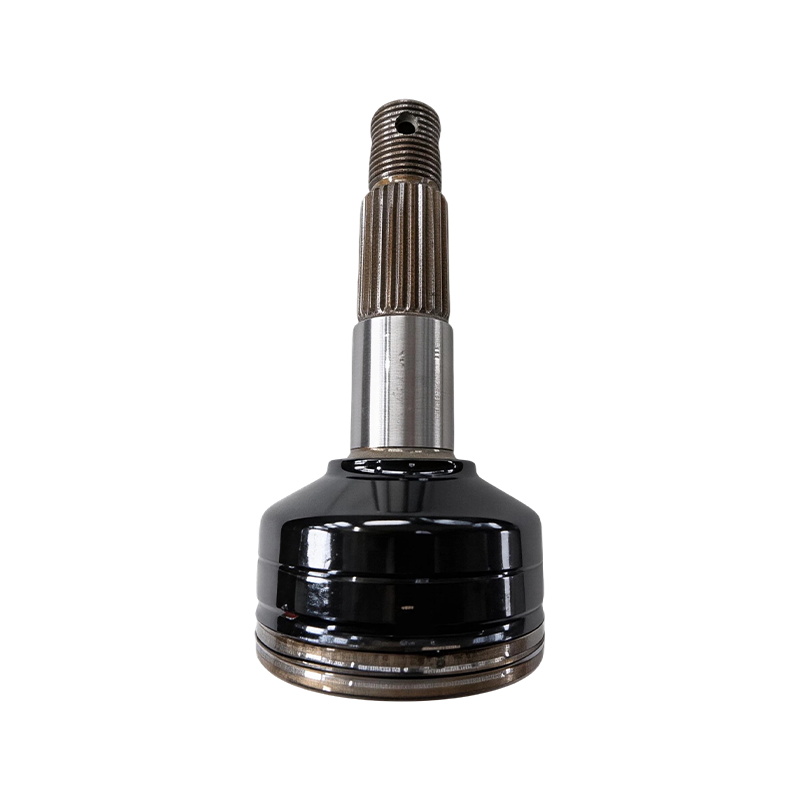 Outer CV Joint for Drivetrain and Steering LoadsMature outer CV joint design supports high-angle steering and intense loads, with alloy steel, boot, and MoS2 grease for drivetrain repair.View Product →
3. Clunking or Shuddering During Acceleration
A dull thump felt through the floor as you accelerate from a standstill points to play in a universal joint, a worn spline, or a collapsed centre support bearing. Rear-wheel drive and four-wheel drive vehicles show this more often, because the noise travels along a longer shaft and is transmitted through the body structure. On front-wheel drive cars the same complaint usually appears as a shudder rather than a single knock.
4. High-Pitched Squeaking That Rises With Speed
A continuous squeak or chirp whose pitch climbs as you accelerate is usually a dry universal joint or a centre support bearing whose grease has hardened. It is easy to mistake for a belt or a brake wear indicator, but a belt squeal changes with engine rpm and a brake squeal changes with braking force. This one changes only with vehicle speed.
5. Metallic Rattle and Loose Knocking Over Bumps
When the rubber insulator in a centre support bearing tears through, the shaft is no longer held on its proper axis. You then hear a loose metallic rattle over broken surfaces, often combined with a vibration that comes and goes depending on load. At this stage the shaft can move far enough to contact the floor pan or exhaust, and the repair stops being a maintenance item.
6. Visible Evidence Under the Car: Thrown Grease and Rust Powder
Once an inner or outer boot splits, grease is flung outward by centrifugal force and sticks to the surrounding underbody, mixing with road dust into a black paste. Orange-brown rust powder around the hub end is direct evidence that metal has already been running dry against metal. The boot itself costs very little, but by the time it fails openly, the joint it protects is usually already damaged.
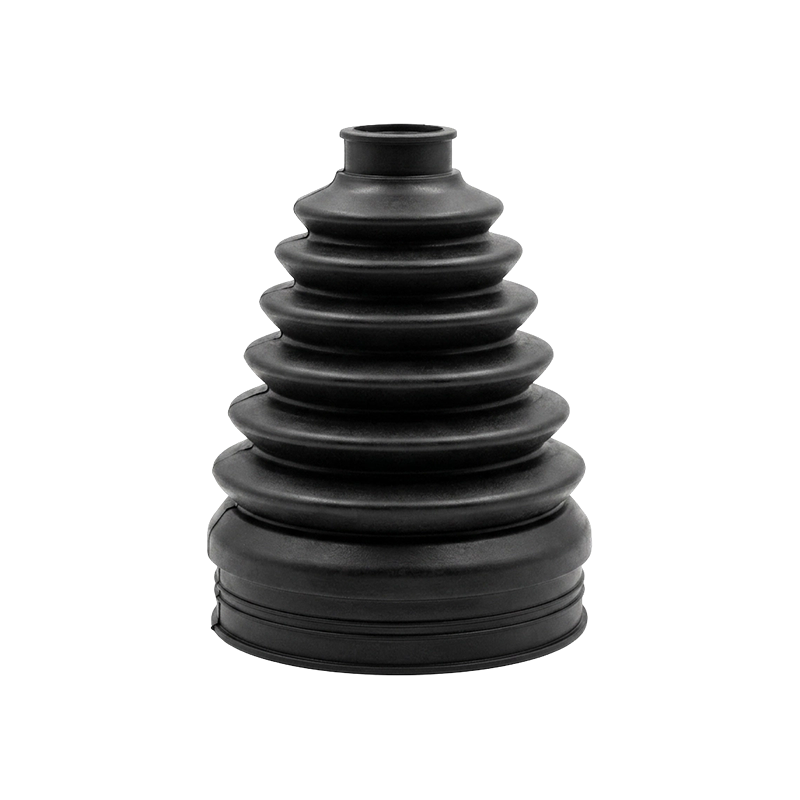
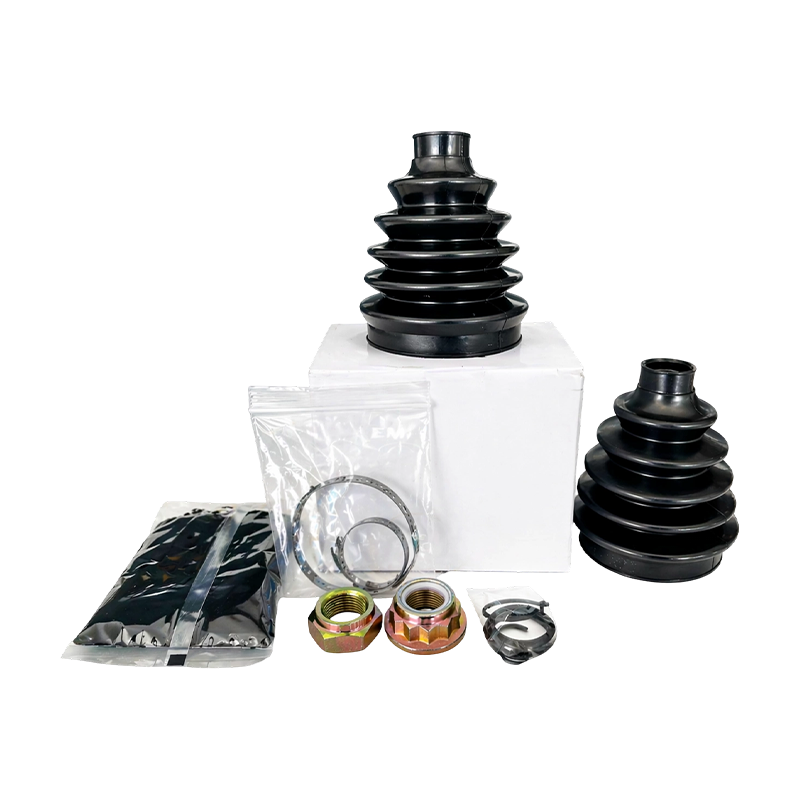 CV Boot Kits for Drivetrain Seal RepairAll-in-one repair kits include CR or TPEE boots, MoS2 grease, and stainless steel clamps matched to OE specifications for worn joints.View Product →
For a closer look at how the boot governs joint life and when replacement makes sense, see why the CV dust boot decides how long the joint lasts.
Why Front-Wheel, Rear-Wheel and All-Wheel Drive Fail Differently
The driveline layout determines which component wears first and which symptom shows up earliest. Comparing the three arrangements makes diagnosis much faster.
| Layout | Structural Feature | Earliest Symptom | First Component to Wear |
|---|---|---|---|
| Front-wheel drive | Constant velocity joints link gearbox to wheels at large angles | Clicking on low-speed, large-angle turns | Outer CV joint and its boot |
| Rear-wheel drive | One long shaft with a universal joint at each end plus a centre support bearing | Speed-related vibration, thud on take-off | Universal joint spider and centre support bearing |
| All-wheel drive and ATV / UTV | Two or more shafts running at steeper angles under heavier loads | Vibration from the centre and rear of the body | Universal joints, splines and joint mating faces |
The practical takeaway: if the noise is at the front and tied to steering angle, think CV joint. If it is under the centre of the car and tied to road speed, think shaft balance, universal joint or support bearing.
A Ten-Minute Road Test You Can Run Yourself
Before booking a workshop slot, this sequence narrows the diagnosis down considerably. It costs nothing but fuel and a torch.
- In an empty car park, accelerate gently from a standstill to about 20 km/h with the windows down. Listen for a single clunk at the moment of take-off.
- On a straight road, accelerate to 100–110 km/h and hold a steady speed. Note the speed band where vibration peaks. Then lift off and coast. If the shake clearly reduces, the balance or a universal joint is the likely source rather than a tyre.
- Find an open junction and drive three complete full-lock turns in each direction at low speed. Rhythmic clicking that slows as the wheel slows confirms an outer CV joint.
- Jack up the front of the car and grip the tyre at the 3 o'clock and 9 o'clock positions, rocking it back and forth. Play here directs attention to the tie rod and hub bearing, and those must be ruled out before blaming the shaft.
- Shine a torch on the joint boots from the inner side. Cracks, loose clamps or grease seepage mean the assembly should be planned for replacement — the boot is rarely worth changing alone once it has opened.
What Fails First, and the Order It Usually Follows
The boot almost always goes before the joint. Rubber hardens under heat, ozone and constant flexing, the clamp loses tension, grease escapes outward and water and grit travel inward. The outer joint is next, because it has to tolerate both steering angle and drive angle at the same time. After that come the inner joint, the splines and the centre support bearing, in roughly that order.
This sequence matters commercially. Replacing a boot on a joint that is still tight is inexpensive and restores full service life. Replacing a joint that has already run dry means replacing the whole shaft assembly, because regrinding a worn raceway is not cost-effective at service volume. The cost difference between the two decisions is typically several times the price of the boot.
Telling a Driveshaft Problem Apart From Look-Alike Faults
Several unrelated faults produce sounds that owners describe in almost identical words. These distinctions resolve most of the confusion quickly.
| Symptom | More Like the Driveshaft | More Like Something Else |
|---|---|---|
| Vibration | Grows steadily with road speed, eases when coasting | Tyre imbalance, appearing in one narrow speed band only |
| Continuous hum | Pitch unchanged when changing lanes | Hub bearing, pitch changes clearly when loading left or right |
| Noise on turns | Only at large steering angles, beat follows wheel rotation | Tie rod or stabiliser link, heard mainly over bumps |
| Shudder on take-off | Only at the moment of engagement, then disappears | Engine mount or ignition fault, with rough idle as well |
What to Verify Before Ordering a Replacement
Driveline parts are fitment-sensitive, and a shaft that looks identical on a photograph can be wrong in five separate ways. These are the checks that prevent returns.
- Overall compressed length and spline count — a few millimetres of difference changes the plunge travel and loads the joints.
- ABS tone ring tooth count — the wrong count triggers a wheel speed fault that has nothing to do with the shaft itself.
- Boot material and clamp type — chloroprene rubber resists heat and ozone well, and the clamp must hold tension across the full temperature range.
- Grease specification and fill quantity — under-filling shortens joint life, over-filling can rupture the boot from internal pressure.
- Balance standard for the complete assembly — a shaft balanced as a bare tube can still vibrate once joints and boots are fitted.
For buyers sourcing for OEM programmes, aftermarket distribution or custom development, the practical answer is to work from a supplier who controls the rubber parts and the transmission parts under one quality system, since the boot, the joint and the shaft interact directly. Manufacturers such as Cixi Quaconst Precision Machinery coordinate rubber, driveline and precision structural production across three specialised plants, which is what allows a complete shaft assembly — tube, joints, boots and hardware — to be validated as one unit rather than assembled from mismatched sources.
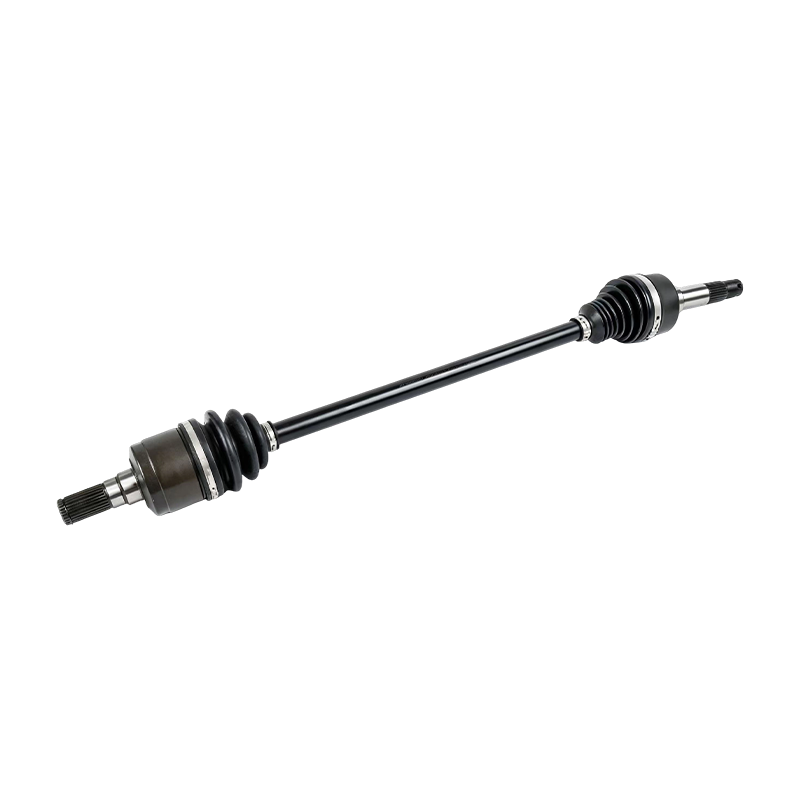
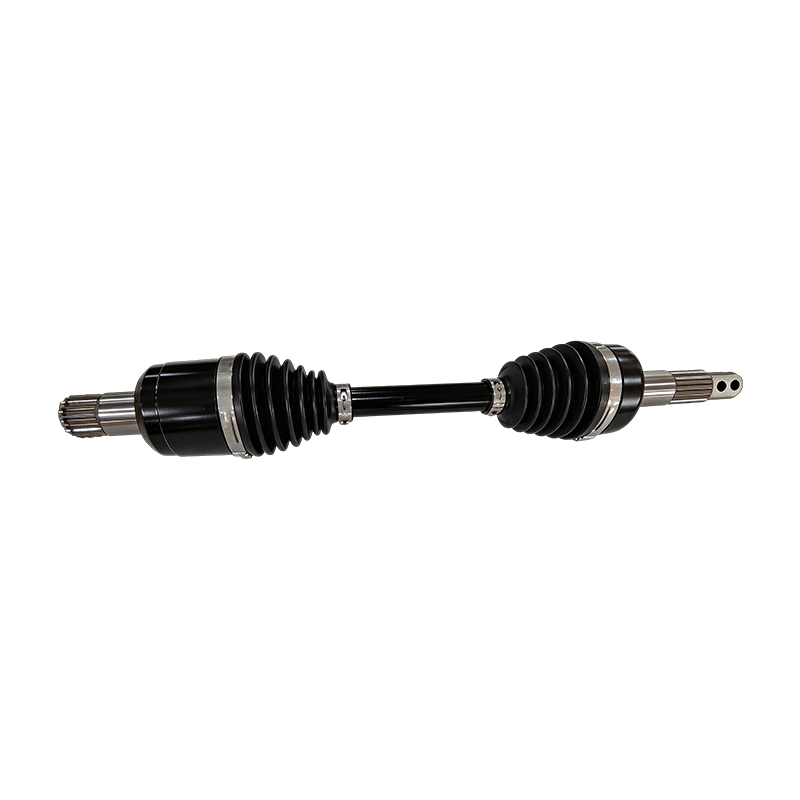 CV Axle Assembly and Drive ShaftOE-standard axle assembly uses CNC machining, heat-treated alloy steel, and modular design for balanced drivetrain performance in passenger and commercial vehicles.View Product →
The short version: vibration that follows road speed, clicking on turns, and a clunk on take-off are the three signals worth acting on. Boots are cheap and joints are not, so the moment grease starts escaping, the economics already favour replacing the whole assembly. Confirm the symptom with a short road test, rule out the tyre and bearing look-alikes, then verify length, spline count and balance standard before the part ships. Doing those three things in that order is what keeps a vibration complaint from turning into a second repair.

MAIL US
CONTACT US
+86 133 0665 0391
MAIL US
No. 169 Songpu Road, Cidong Industrial Zone, Cixi City, Ningbo City, Zhejiang Province, China
 OEM/ODM Automotive Chassis Sealing Components Manufacturer
EV Drivetrain Components Supplier